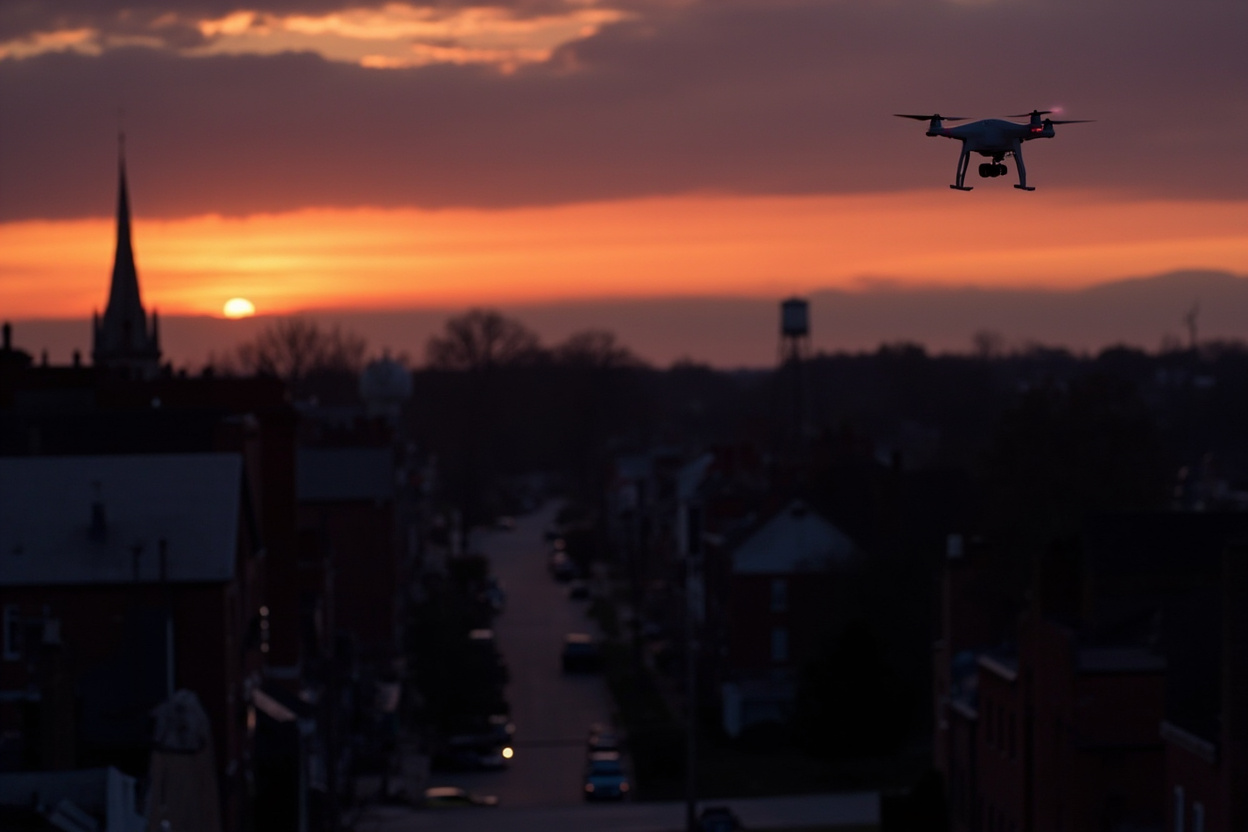
Springfield was just selected for the nation's first statewide drone first responder program. Here's what the city isn't talking about.
When Springfield Police, Fire, and EMS were named one of nine Ohio agencies selected for the state's Drone First Responder pilot program in February, State Representative Bernard Willis called it historic.
"In Ohio, the HOME of aviation we are the BEST at making historic innovations with flying machines," Willis said.
The $2.5 million program, funded entirely by the state through House Bill 96, puts camera-equipped drones on Springfield rooftops that can launch autonomously, fly beyond an operator's line of sight, and stream live video to command staff in real time. The technology can reach a scene in 90 seconds. A patrol car takes 10 to 15 minutes.
On paper, it's a public safety win. In practice, it raises questions that Springfield residents deserve answers to before drones start buzzing overhead.
How It Works
The Ohio DFR program uses "drone-in-a-box" systems: permanent docking stations, typically mounted on rooftops, that house drones capable of launching with a click from a desktop computer. An operator picks a call from the dispatch interface, hits launch, and the drone is airborne.
The live video feed streams to headquarters, where supervisors can monitor the situation in real time. Officers heading to the scene get the same feed on their phones, giving them a head start on assessing what they're walking into.
The drones are equipped with 4K cameras, spotlights, and speakers. Some models can drop medical supplies. Each carries about 40 minutes of flight time with an equal recharge period. The equipment must be NDAA-compliant, meaning no Chinese-manufactured components.
Springfield pays nothing for the technology during the pilot. The state covers it through ODOT and DriveOhio, with program management support from SkyfireAI. The city's only obligations are providing a launch site, staff to operate the drones, and handling maintenance.
The other eight agencies selected: Athens Police Department, Lima Police Department, Toledo Police Department, Violet Township Fire/EMS, Austintown Fire Department, City of Hamilton Police/Fire/EMS, Amherst Police Department, and Kelleys Island Fire/EMS.
The Pitch: A Force Multiplier
Supporters of DFR programs point to impressive results, and they're not wrong.
Chula Vista, California, launched the nation's first DFR program in October 2018. Since then, drones have responded to over 20,000 calls and assisted in more than 3,000 arrests. On priority calls, drones arrive in about 3.5 minutes, less than half the time it takes a patrol car.
In one widely cited case, a drone identified that what appeared to be a man waving a gun outside a restaurant was actually a novelty lighter. Officers were able to approach calmly instead of drawing weapons. Without the drone, a mentally ill man might have been shot.
In Minnetonka, Minnesota, which launched its program in August 2025, drones arrive first on scene 70% of the time. About 20% of calls are cleared without ever sending a patrol unit, freeing officers for higher-priority work. The program costs roughly $300,000 per year.
In Brooklyn Park, Minnesota, a domestic assault suspect was tracked by drone and told officers upon being caught: "I could see the drone. I knew I wasn't gonna get away."
"If you're a law-abiding citizen, it's going to be great. If you're a criminal, it's gonna be horrible news," said a sergeant with Hamilton Police, another Ohio pilot agency.
The Problem Nobody Wants to Talk About
Here's where things get uncomfortable.
Twenty-five miles from Springfield, Dayton city workers are covering 72 Flock Safety cameras with trash bags.
The reason: an investigation found more than 7,000 cases where outside law enforcement agencies searched Dayton's license plate reader data for immigration enforcement purposes, something the city's own policy explicitly prohibited. Officials called the violations "egregious."
Dayton spent $825,750 on those cameras in 2024, plus a $90,000 grant for more. Now they're spending $30,000 to audit how the data was misused.
Dayton isn't alone. Evanston, Illinois covered its Flock cameras after discovering ICE data sharing. Oxnard, California suspended its system after a vendor-enabled "nationwide query" gave unauthorized agencies access. Renton, Washington paused its cameras after public outcry. Business Insider called it "a growing rebellion against Flock cameras playing out one trash bag at a time."
And Springfield isn't watching from the sidelines. A Dayton Daily News investigation found that ALPRs are used by law enforcement agencies across southwest Ohio, including Springfield and Clark County. The paper is actively seeking audit data from these agencies to determine how their data is being shared.
The question writes itself: if we can't even trust license plate cameras to stay in their lane, what happens when we add drones with live video feeds?
"It Can Be Whatever You Want"
The Flock camera scandal reveals a structural problem that applies directly to drone programs.
When law enforcement officers search a Flock database, they're supposed to state a reason. In practice, the reasons are often "investigation," "investigation pending," "other," or just a string of numbers. As one community advocate in Dayton put it: "It can be whatever you want. You just type it in. There's literally no safeguard."
Flock says it has no direct contracts with ICE. But the company acknowledges nothing stops its customers from sharing data with federal authorities. The real access happens through what privacy experts call "side-door handshakes": local agencies running searches on behalf of federal immigration enforcement, or simply granting access through the same networked platform.
Ohio's DFR program hasn't published detailed data retention policies, footage access rules, or audit requirements. HB 96 created the program but doesn't appear to include specific privacy protections.
Compare that to Minnesota, where state law limits drones to 11 specific uses without a warrant. Ohio has no comparable restriction.
What the ACLU Is Actually Saying
The American Civil Liberties Union's position on police drones is more nuanced than critics give them credit for.
"We are not against drones in policing," said Jay Stanley, an ACLU senior policy analyst. The organization sees clear benefits for finding missing people, guiding officers to emergencies, and providing real-time information that can de-escalate dangerous situations.
The concern is what comes next.
"Police departments are on their best behavior when a technology is new, when it's edgy, when it's kind of controversial," Stanley said. "But if it becomes normalized, if it becomes accepted, that's when we see that some departments will start to push the limits and start using it for routine surveillance."
The ACLU points to Baltimore as the cautionary tale. In 2016, Baltimore police secretly used aircraft-mounted cameras to conduct months of aerial surveillance over the city following police protests. Residents were never told. The ACLU sued, and a federal appeals court ruled the program violated citizens' Fourth Amendment rights. It was dismantled by 2021.
"Communities should look very closely at these kinds of programs," Stanley said. "And if they decide to allow them, then they should put in place careful checks and balances to make sure that they don't turn into something bigger."
In Minneapolis, where the city council is currently weighing a DFR proposal, the ACLU of Minnesota raised similar concerns. "The more drones are used, the more you have the risk of essentially warrantless surveillance," said Munira Mohamed, a policy associate with the organization.
One Minneapolis council member captured the tension perfectly: "I personally found myself oscillating between 'Wow, this could be extremely useful' and 'Oh my God, this is Big Brother coming to ruin our lives.'"
What We Don't Know Yet
It's worth noting what hasn't been publicly disclosed about Springfield's participation in this program:
- No third-party study has ever proven that DFR programs reduce crime. MIT Technology Review reported in 2023 that no experts, including officers in Chula Vista, could point to independent evidence that drones actually bring crime numbers down. Response times improve. Situational awareness improves. Whether that translates to deterrence is an open question.
- No published data policy. How long will Springfield store drone footage? Who can access it? Can other agencies request it?
- No public transparency portal. Chula Vista publishes every flight path with corresponding case numbers. Arlington, Texas does the same. Has Springfield committed to anything comparable?
- No clear post-pilot plan. The state is paying now. When the money runs out, Springfield either pays or loses the program. Minnetonka's program costs $300,000 per year. Has anyone estimated Springfield's ongoing cost to taxpayers?
The Right Questions
None of this means Springfield should reject the DFR program. The technology genuinely saves lives. The lighter-not-a-gun story from Chula Vista is one of dozens of examples where aerial information prevented bad outcomes.
But "free drones from the state" shouldn't be the end of the conversation. It should be the beginning.
Springfield residents should be asking:
- What is the data retention policy? How long is drone footage stored? Chula Vista maintains a public transparency portal with flight paths and case records. Will Springfield?
- Who can access the footage? The Dayton Flock scandal proved that "local use only" policies mean nothing without enforceable safeguards. What prevents drone footage from being shared the same way license plate data was?
- Is there a civilian oversight mechanism? Who reviews complaints about drone operations? Is there an independent body with authority to audit the program?
- What are the rules of engagement? Can drones be deployed for protests? Community events? Routine traffic? Chula Vista has trimmed its response criteria over the years after listening to privacy concerns. Has Springfield defined any limits?
- What happens after the pilot? The state is funding this now. When the money runs out, Springfield either pays or loses the program. Has anyone estimated the ongoing cost?
- Was there public input? Did this go before the City Commission? Was there a public comment period? Were community organizations consulted?
- How does this stack with existing surveillance? Springfield already has automated license plate readers. Dayton's experience shows that surveillance tools compound each other in ways that nobody planned for. Has anyone mapped the cumulative effect?
The Bottom Line
Chula Vista's police chief said the biggest mistake a department can make when launching a drone program is leaving residents in the dark.
"Before we ever flew a drone, we had a policy in place. We had worked with people. It made it much easier as we progressed through the whole process," she said.
Springfield has an opportunity to do this right. The technology is real. The benefits are documented. But so are the risks, and they're not hypothetical. They're playing out in real time, 25 miles down I-70, where a city is covering its surveillance cameras with trash bags because it lost control of its own data.
The drones are coming. The question is whether Springfield will fly them with transparency, accountability, and community trust, or whether residents will find out what's overhead the same way they usually do: after the fact.
Sources
- WHIO, "Springfield chosen to participate in nation's first Statewide Drone First Responder Pilot Program" (Feb 10, 2026)
- WCPO, "Hamilton police are getting drones that beat officers to the scene" (Feb 27, 2026)
- Fortune, "Dayton is covering Flock cameras with trash bags after officials found data use violated policy" (June 3, 2026)
- Springfield News-Sun/Dayton Daily News, "Area police share license plate reader data for immigration, unstated reasons" (May 2026)
- InvestigateTV, "Police drone programs expand as first-responder tool, raising privacy concerns" (Feb 6, 2026)
- ACLU, "Autonomous Drone Patrols Start to Become a Thing" (Oct 17, 2025)
- GovTech, "Drone Cops: The Future of Policing American Cities?" (Nov 19, 2024)
- MIT Technology Review, "Welcome to Chula Vista, where police drones respond to 911 calls" (Feb 27, 2023)
- Star Tribune/MinnPost, "Minneapolis weighs drones as first responders, sparking privacy debate" (May 28, 2026)
- Business Insider, "A growing rebellion against Flock cameras is playing out one trash bag at a time" (June 1, 2026)
- DroneLife, "Ohio Launches Nation's First Statewide Drone First Responder Program" (Oct 8, 2025)
- AUVSI, "Ohio's Statewide Drone First Responder Program Takes Flight" (Oct 9, 2025)
- The Guardian, "Despite TPS stay, thousands of Haitians in Ohio face uncertainty" (Feb 3, 2026)
- Chula Vista PD, Official UAS Program Page