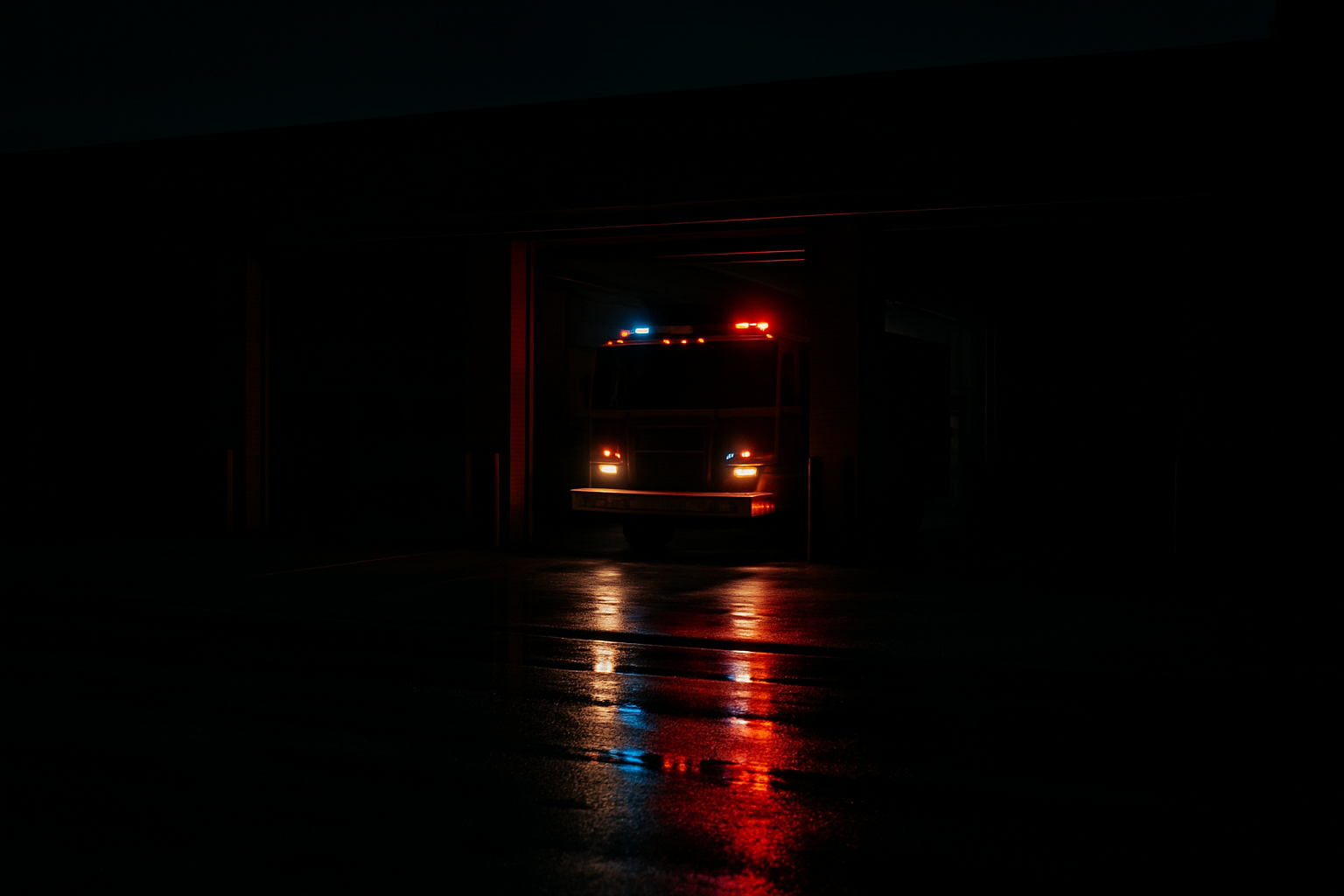
If you've been following the news out of Springfield Fire Rescue lately, you already know things are strained. Station 6 went dark on a Sunday night in April. The city stopped requiring mandatory overtime, not because the staffing picture improved, but because firefighters and their families were burning out. The union sent a letter calling the resulting coverage reductions "unsafe and irresponsible."
There's been a lot of back and forth between the city and the union about what happened and why. But one question keeps getting buried under the argument: by any objective measure, where does Springfield's fire staffing actually stand?
We went and found out.
The Current Situation
Springfield Fire Rescue runs 6 stations (Stations 1, 4, 5, 6, 7, and 8) covering roughly 57,900 residents.
On the books, the division has 129 total members. The city charter sets a minimum of 127, with an authorized strength of 130. That sounds close to full.
It's not.
Fire Chief Jacob King told the Springfield News-Sun that as of mid-April, 29 of those members aren't available for frontline duty:
- 11 are on Family Medical Leave
- 5 are on modified duty recovering from injuries
- 3 are deployed with the military
- 10 are new hires who won't finish the academy until the end of April
Do the math and you get about 93 people actually available to work, spread across six stations and three rotating 24-hour shifts, every day of the year.
City Manager Bryan Heck put it plainly: "No organization can fully prepare or adequately staff when you have 19-20 people out."
So How Do You Measure This?
The standard yardstick for comparing fire departments is career firefighters per 1,000 residents. It's not perfect, but it lets you put different-sized cities on roughly the same scale.
For Springfield:
| Scenario | Rate per 1,000 |
|---|---|
| At authorized strength (130 members) | 2.24 |
| At current available strength (~93 members) | 1.61 |
That authorized rate would be strong. The effective rate tells a very different story.
Stacking Up Against Similar Ohio Cities
To put those numbers in context, here's how other mid-size Ohio cities with career fire departments compare:
| City | Population | Firefighters | Per 1,000 | Stations |
|---|---|---|---|---|
| Springfield (authorized) | ~57,900 | 130 | 2.24 | 6 |
| Springfield (available) | ~57,900 | ~93 | 1.61 | 6 |
| Newark | ~51,400 | 94 | 1.83 | 4 |
| Mansfield | ~46,000 | 92 | 2.00 | 6 |
| Lima | ~34,700 | ~70 | 2.02 | 5 |
At full strength, Springfield tops the list. At the current effective level, it sits below every peer city in this comparison.
For broader context, the NFPA reports that career departments serving communities of 50,000 to 99,999 people typically fall between 1.5 and 2.5 firefighters per 1,000, with most landing somewhere around 1.7 to 2.0. Springfield's effective 1.61 puts it near the bottom of that window.
What Do National Standards Actually Require?
NFPA 1710
NFPA 1710 is the nationally recognized standard for how career fire departments should be organized and deployed. It's not law, but it's the benchmark everyone references: fire departments, unions, city managers, and insurance rating organizations.
The highlights:
- Every engine company should roll with at least 4 firefighters
- The first engine should be on scene within 4 minutes of travel time
- A structure fire needs 15 to 17 firefighters on scene within 8 minutes for the initial alarm
- High-call-volume and urban response zones should bump engine staffing to 5 or 6
The NIST Study Everyone Cites
In 2010, the National Institute of Standards and Technology ran a controlled study on residential structure fires to test whether crew size actually matters. (Spoiler: it does.)
What they found:
- Four-person crews finished 22 critical tasks 25% faster than three-person crews
- On the 14 highest-risk tasks, three-person crews took almost 12 minutes longer than four-person crews
- Search and rescue was 30% faster with four on the truck
- Water delivery to the fire was 6% faster with four-person crews
Twelve minutes might not sound dramatic in the abstract. On a residential fire with people still inside, it's enormous.
The Demand Side: Call Volume
None of the staffing numbers mean much in isolation. What matters is how many calls those firefighters are running.
Springfield Fire Rescue set a record in 2024 with over 19,500 total responses:
- 16,776 EMS calls (by far the largest share)
- 543 fire calls (84 building fires, 69 vehicle fires, 390 minor incidents)
- 712 false alarms
- 1,525 other calls
One stat that deserves its own paragraph: according to Chief King, roughly 3,300 to 3,500 of those calls each year, about 60%, go to skilled nursing and assisted living facilities for patients who need transport to the hospital but aren't experiencing a medical emergency. Every one of those calls ties up a crew and an ambulance that could be responding to something more urgent.
The city passed an ordinance last year letting the fire division charge fees for repeated non-emergency calls. It's a smart move, but it hasn't dented the volume yet.
Here's what that workload looks like per person:
- At full authorized strength: roughly 150 calls per firefighter per year
- At current available strength: roughly 210 calls per firefighter per year
That's a 40% increase in per-person workload over what the department was built to handle.
What "Browning Out" Looks Like in Practice
"Browning out" isn't closing a station. The building stays open. But one or more pieces of apparatus, an engine, an ambulance, or both, get pulled from service because there aren't enough people to staff them.
Station 6 on South Charleston Pike has been the primary target. It operates as a "combo" company: one crew covers both the fire engine and the ambulance, responding on whichever vehicle the call requires. If they're out on an EMS run, the engine sits. If the whole station is browned out, neither unit is available.
For the neighborhoods in Station 6's first-due area, that means waiting longer. The next closest station picks up the call, assuming they aren't already out on one of their own.
The fire department points to mutual aid agreements with surrounding communities as a safety net. That's true, and mutual aid works well for large-scale incidents. But it was never designed to be a daily staffing substitute.
The Overtime Spiral
Before the city pulled the plug on mandatory overtime, the situation had gotten untenable.
In just the first three and a half months of 2026, firefighters worked 1,775 hours of mandatory overtime. That's about 40% of the total mandatory overtime for all of 2025, packed into one quarter.
When you add voluntary overtime on top of that, total overtime reached 7,393 hours over the same period.
This isn't just a scheduling headache. Fatigue in emergency responders is a well-documented risk factor. Firefighters pulling back-to-back shifts have slower reaction times, higher injury rates, and make more errors under stress, in a job where those errors can be fatal.
Chief King says stopping mandatory overtime was about protecting members' health and families. The union says it traded one crisis (burnout) for another (reduced coverage). It's hard to argue with either of them.
What's Being Done About It
Credit where it's due: the city isn't sitting still.
Lateral entry is open. Voters approved a charter change in November 2025 that lets the city recruit experienced firefighters from other departments. The traditional path, civil service exam through full certification, takes about three and a half years. A lateral hire with existing certs can be on the street in roughly five weeks. The city posted its first lateral entry application and already has five candidates interested.
Academy class wrapping up. Ten new firefighters are expected to finish the academy by April 30, which should immediately help with shift coverage.
Non-emergency fee ordinance. The intent is to push facilities that repeatedly call 911 for non-emergent transport toward private ambulance services, freeing up fire and EMS crews for actual emergencies.
And despite all of this: Springfield Fire Rescue was named Ohio's 2026 Fire Department of the Year by the state's Division of EMS. Whatever challenges exist at the organizational level, the people showing up for those shifts are still delivering high-quality service.
The Takeaway
Springfield's fire staffing gap isn't complicated. The city has 130 authorized positions and about 93 people available to fill them. That 28% shortfall is the root of every headline you've read in the last few weeks.
Fully staffed, Springfield would rank among the best-resourced fire departments in its class. At the current effective level, it falls below comparable Ohio cities and sits near the floor of national benchmarks.
The lateral hiring program, the academy graduates, the non-emergency fee ordinance: these are all the right moves. Whether they come together fast enough is the open question.
In the meantime, the math is simple. Ninety-three firefighters and paramedics are covering a city of nearly 58,000 across six stations, running more than 19,000 calls a year. They won a statewide award doing it.
The people aren't the problem. The gap is.
Sources: Springfield News-Sun (April 14 & 17, 2026), Dayton 24/7 Now (April 2026), City of Springfield, NFPA 1710 Standard (2020 Edition), NIST Residential Fireground Field Experiments (2010), IAFF, USFireDept.com, Ohio Demographics, city department websites for Mansfield, Lima, and Newark.
OpenSpringfield is an independent civic transparency project and is not affiliated with the City of Springfield. Learn more about us →