On August 6, 2024, Toni Carter-White carried her belongings out of the Executive Inn in plastic trash bags, her son beside her. A city bus waited in the parking lot to shuttle her and 21 other displaced families to Sheltered Inc.'s congregate shelters across town. The Springfield City Commission had killed Homefull's contract the night before, 3-2, and the Dayton-based nonprofit had no choice but to shut down immediately.
Diapers. Hygiene products. Children's clothing. All of it in garbage bags while Springfield police officers helped carry what they could.
"Contracts don't get renewed, that's fine," Homefull CEO Tina Patterson said that day. "But never in this manner."
Nine months later, Springfield called her back.
The Phone Call
In November 2025, with Sheltered Inc. circling the drain and every indicator pointing toward collapse, Springfield's leadership reached out to the organization they'd shown the door barely a year earlier.
Mayor Rob Rue was blunt about it at the May 19, 2026 City Commission meeting: "This is a full circle vote to an organization that obviously is doing good work in the Dayton area and has great marks across the state."
Full circle. That's one way to describe it. Here's another: Springfield spent 18 months dismantling its homeless services infrastructure through a combination of funding disputes, political disagreements, and a lawsuit, then ran out of options and ended up right back where it started. Only now there are fewer beds, less capacity, and a bankruptcy filing in between.
What the New Deal Looks Like
The contract the commission approved on May 19 gives Homefull a one-year agreement worth up to $853,758 for emergency shelter operations and supportive services, with an option to renew for a second year. Two days later, on May 20, the Clark County Board of Commissioners added just under $400,000 in Temporary Assistance for Needy Families funds for shelter and case management.
Combined: roughly $1.25 million in city and county funding.
The new shelter opens Friday, May 22, at the former Fire Station No. 5 on Commerce Road. It will serve the 14 men, five women, and four families (including six children) currently in Sheltered Inc.'s care before those doors close for good the same day.
Under the agreement, Homefull handles all day-to-day operations: intake, facility management, service coordination, and supportive services for single men, single women, and families with children. Beyond emergency shelter, the contract covers housing placement assistance, case management, employment support, and connecting residents to local resources. It's designed as a bridge to long-term stability, not just a place to sleep.
Springfield Director of Community Development Logan Cobbs told the commission that "many nonprofits did not have the capacity to help Springfield" and that "Homefull was the only provider willing to help right now."
That sentence deserves attention. Most providers looked at Springfield's track record with homeless services and passed.
A Quick Rewind: What Happened at the Executive Inn
To understand why this deal matters, you need the full picture of how Springfield got here. Our previous article covered the Sheltered Inc. bankruptcy in detail. This is the other half of the story.
In January 2023, the city spent $2.2 million in American Rescue Plan Act funds to purchase the Executive Inn and convert it into a non-congregate emergency shelter. Non-congregate means private rooms, not rows of cots. Families behind closed doors. Locks, bathrooms, basic dignity. Springfield approved a $1.34 million contract with Homefull to operate the site that April.
This happened in a Springfield that was already under enormous pressure. The city was absorbing an estimated 15,000 to 20,000 Haitian migrants under Temporary Protected Status, a population influx that was reshaping the local housing market, straining public services, and generating national headlines. Housing competition was intensifying across every price point. The homeless services question was playing out against a backdrop of real scarcity, real frustration, and real political tension.
By all accounts, Homefull ran the shelter well. Mayor Rue said the city held them "to the highest standard." When the contract renewal came up in late July 2024, Rue called their work excellent.
But there were legitimate questions too, and they deserve honest treatment.
The Concerns That Killed the Contract
When Commissioner Tracey Tackett voted no on July 30, 2024, she pointed to specific issues. The Executive Inn had roughly 80 rooms. Only 22 were occupied. Tackett noted the facility had no capacity for single men or families with adult children, limiting who it could actually serve. At the time, she told reporters: "When I see the dollar amount of $1.7 million, I wonder is this the best use of our funds for one year on 22 rooms at the Executive Inn."
That cost-per-room math, roughly $47,000 per occupied room per year, is a fair question for a commissioner to ask. On the surface, it's a lot of money for 22 families.
But the math has context that matters. The contract was structured as reimbursement-based, meaning Homefull only got paid for services actually rendered. The $1,047,436 figure was a ceiling, not a guaranteed payout. If occupancy stayed at 22 rooms, the actual cost would have been lower. And the contract included not just shelter but wraparound services: case management, housing placement, employment support, the full continuum that helps people actually exit homelessness rather than cycle through it.
There was also a referral problem that wasn't Homefull's fault. Mayor Rue noted that local organizations weren't sending people to the Executive Inn, leaving 8-12 rooms chronically empty. That's a system coordination failure, not a provider performance issue. Homefull couldn't fill rooms if nobody was sending people to them.
The special meeting on August 5, 2024 was called for the sole purpose of addressing the contract. The vote went 3-2 against: Tackett, Commissioner Krystal Brown, and assistant mayor Dave Estrop voted no. Rue and Commissioner Bridget Houston voted yes.
Tackett became emotional during the meeting, saying she was standing up for what community members asked of her. Her comments were met with applause. This wasn't a commissioner acting on a whim. There was genuine community sentiment behind the vote.
Estrop said he was putting his faith in Sheltered Inc.
The next morning, families were loading plastic bags onto a city bus.
What Happened Next
What happened immediately after the vote was chaotic. Twenty-two families were moved out in a single day. OIC of Clark County, the anti-poverty nonprofit led by executive director Mike Calabrese, scrambled to place them. Most went to Sheltered Inc.'s congregate shelters. Eight to ten families were put in hotels, funded by OIC for up to 60 days.
Mayor Rue pointed out what the families lost in the transition: private rooms with locks, individual bathrooms, 24-hour access. Sheltered Inc.'s shelters were congregate (open rooms) and operated only 12 hours a day at the time.
"These people deserve more than what they got today," Rue said.
Homefull's CEO had a broader reaction: "A system should have been developed that has the ability to expand and contract when it's needed. It's not about one organization or another. We were so excited about that opportunity."
The Clark County Board of Commissioners terminated its contract with Homefull the following week. Homefull was out of Springfield entirely.
The Collapse
Estrop's faith in Sheltered Inc. didn't survive the year.
Without Homefull, Sheltered Inc. became Springfield's sole homeless shelter provider. An organization that was already financially underwater, locked in a $500,000 lawsuit with the county over TANF documentation issues, ineligible to access TANF funding, and surviving month-to-month on emergency funding from OIC.
The full timeline of Sheltered Inc.'s decline is in our previous article, but the highlights: three executive directors in one year, warnings of closure as early as May 2024, a $300,000 operating deficit, and eventual bankruptcy filing in April 2026. All shelters close May 22. Final operations end May 30.
The warning signs were visible in August 2024 when the commission voted. By then, Sheltered Inc. had already lost its largest funding source (TANF), was facing a six-figure legal claim, and was being propped up by OIC using ARPA dollars that everyone knew would run dry. The commission chose it anyway.
The Glue That Held It Together
If there's an unsung player in this entire saga, it's OIC of Clark County and its former executive director, Mike Calabrese. For more than two years, Calabrese's organization bridged every funding gap. When the county pulled TANF from Sheltered Inc. in 2023, OIC stepped in with ARPA dollars. When Homefull was voted out and families needed placement, OIC coordinated the response. When Sheltered Inc. needed month-to-month funding to keep the lights on through 2024 and into 2025, OIC provided it.
Calabrese retired in February 2025 after leading OIC since 1988. Leslie Crew, former executive director of the Clark County Family and Children First Council, replaced him. The timing was not great. The one person who had been holding Springfield's homeless services together stepped away just as the last remaining provider entered its final spiral.
OIC's role deserves more attention than it typically gets. While the city and county pointed fingers at each other, while Sheltered Inc. and the county fought over $500,000 in paperwork, while commissioners debated contracts and costs, OIC was the organization that made sure nobody froze on the street.
Who Is Homefull
If you only know Homefull from Springfield headlines, you'd be forgiven for thinking it's a small outfit that showed up to run a hotel shelter and didn't work out. It isn't.
Homefull has been operating since 1988. CEO Tina Patterson has led the organization since 1995. Three decades of continuous leadership at the top. Compare that to Sheltered Inc., which went through three executive directors in its final year alone.
The organization now operates across 16 Ohio counties. In Dayton, its footprint includes:
- The Gettysburg Men's Shelter, a 24/7 emergency shelter that Homefull recently took over
- Affordable housing programs and a growing housing portfolio
- The Gettysburg Grocery, a food access initiative addressing food deserts in low-income neighborhoods
- Workforce development programs connecting people to livable-wage employment
- The 16-Acre Project, a $50 million affordable housing development on Dayton's south side featuring 144 units for households earning less than 80% of area median income
Homefull's most recent IRS Form 990 (fiscal year 2024) shows CEO compensation of $262,818 and a board of 19 trustees providing governance oversight. The organization regularly undergoes federal single audits, required for entities spending $750,000 or more in federal grant money annually.
This isn't a church-network-turned-nonprofit running on shoestring funding and volunteer labor. This is a regional institution with professional infrastructure, decades of operational history, and the kind of financial track record that qualifies it for the federal funds Springfield's homeless services depend on.
Including TANF. Which, it bears repeating, Sheltered Inc. could no longer access.
The Building That Isn't There Anymore
One detail that ties this story in a particularly tight knot: the Executive Inn, the $2.2 million property where Homefull was providing private rooms and wraparound services, is slated for demolition.
The city bought it in January 2023 with ARPA funds. Homefull operated it from April 2023 through August 2024. After the commission killed the contract, the building sat vacant. By early 2026, it was on the demolition list.
Springfield spent $2.2 million to buy a building. Paid over $1.3 million for a nonprofit to operate it. Voted to end that operation after 16 months. Let it sit empty for over a year. And is now tearing it down.
The replacement is a converted fire station.
Commissioner Larry Ricketts noted at the May 19 meeting that using the former firehouse lets the city direct more money toward services rather than acquiring and outfitting a new site. That's true. It also sidesteps the question of why a new site was needed in the first place.
Open Questions
This story is still developing, and several important threads remain unresolved.
Mulberry Terrace. Sheltered Inc. operated 34 units of permanent supportive housing at Mulberry Terrace, 120 W. Mulberry Street, for chronically homeless individuals. That's a different program from emergency shelter. When Sheltered Inc. files for bankruptcy, what happens to those 34 residents? Public reporting hasn't addressed this yet. It should.
The fire station's capacity. How many beds does the converted Fire Station No. 5 actually hold? Reporting describes it as serving the current Sheltered Inc. population (14 men, 5 women, 4 families with 6 children), but the long-term capacity hasn't been disclosed. For context, Sheltered Inc.'s two emergency shelters had combined capacity for roughly 70 beds. The Executive Inn had 80 rooms.
Other providers. Springfield isn't completely without homeless services. The Springfield Rescue Mission has operated for over 130 years, providing food, shelter, and services through a faith-based model. Project Woman serves survivors of domestic violence. But neither is a general-population emergency shelter provider for single adults and families, which is the gap Homefull is filling.
The "All In Clark County" initiative. In early 2026, the city, county, and United Way launched "All In Clark County: Addressing Homelessness Together," a planning initiative backed by a $200,000 grant and managed by Element Consulting Group out of Columbus. The effort will include focus groups, interviews, and data collection to create a long-term plan. That's the right move. But a planning process won't keep anyone warm this winter. The timeline for actionable results is unclear.
The $500,000 lawsuit. Clark County's lawsuit against Sheltered Inc. will now play out against a bankruptcy proceeding. Whether the county recovers any of those funds is an open question. If it doesn't, that's $500,000 that comes from somewhere.
The May 19 vote. The commission approved the Homefull contract, but public reporting hasn't specified whether the vote was unanimous or split. Given the history, it matters.
What This Costs
Let's put the full financial picture in one place.
$2.2 million — City purchase of Executive Inn (ARPA funds, January 2023)
$1.34 million — Initial Homefull operating contract (April 2023)
$1,047,436 — Proposed renewal contract voted down (August 2024, never spent)
$607,000+ — OIC/ARPA funding to Sheltered Inc. (2023–2024)
$67,000+ — City CDBG funds to Sheltered Inc. (December 2025)
$853,758 — New Homefull contract (May 2026)
~$400,000 — County TANF funds to Homefull (May 2026)
$200,000 — "All In Clark County" planning grant (2026)
$500,000+ — County lawsuit against Sheltered Inc. (outcome TBD)
Unknown — Demolition cost for Executive Inn
Unknown — OIC emergency hotel placements and ongoing Sheltered Inc. support (2024–2025)
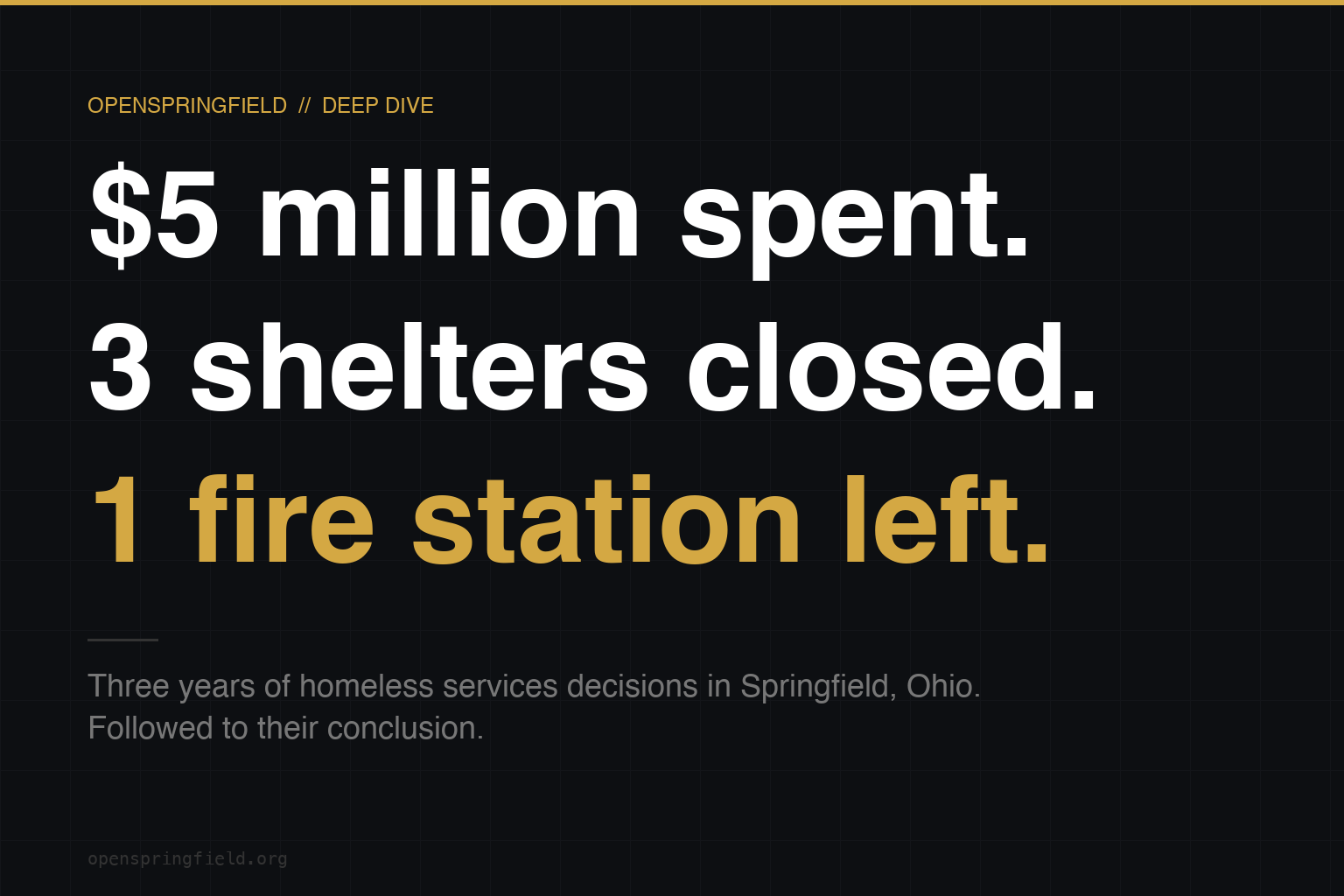
The total public investment in Springfield's homeless services over the past three years comfortably exceeds $5 million. The result, as of this week, is a converted fire station.
Where This Leaves Springfield
Homefull's return is genuinely good news. The organization has institutional credibility, stable leadership, and operational capacity that Springfield hasn't had since it forced them out. The combined city-county funding gives them a more sustainable base than Sheltered Inc. ever had. And their model, focused on housing placement and employment support alongside emergency shelter, addresses the long-term problem instead of just managing the symptoms.
But the situation they're walking into is worse than the one they left. Springfield went from three dedicated homeless shelter facilities (Norm's Place, Hartley House, and the Executive Inn) to a single converted fire station. The 34 residents of Mulberry Terrace face an uncertain future. The only local provider with 35 years of institutional knowledge is gone. OIC, which spent two years holding the system together, is under new leadership navigating a transition. And the political dynamics that produced the August 2024 vote haven't fundamentally changed.
For Homefull, the contract represents a chance to build the kind of system that Tina Patterson described in August 2024: one that can expand and contract with need, grounded in data and coordination rather than lurching from crisis to crisis.
For Springfield, it's a second chance that came at a steep price.
Sources: Springfield News-Sun, Dayton Daily News, WYSO, WDTN, Dayton 24/7 Now, ProPublica Nonprofit Explorer (IRS Form 990 data), Homefull (homefull.org), Dayton Foundation, City of Springfield public statements, Clark County Commission public statements, OpenSpringfield previous reporting.
OpenSpringfield is an independent civic transparency project. We are not affiliated with the City of Springfield, Clark County, or any organization mentioned in this article.