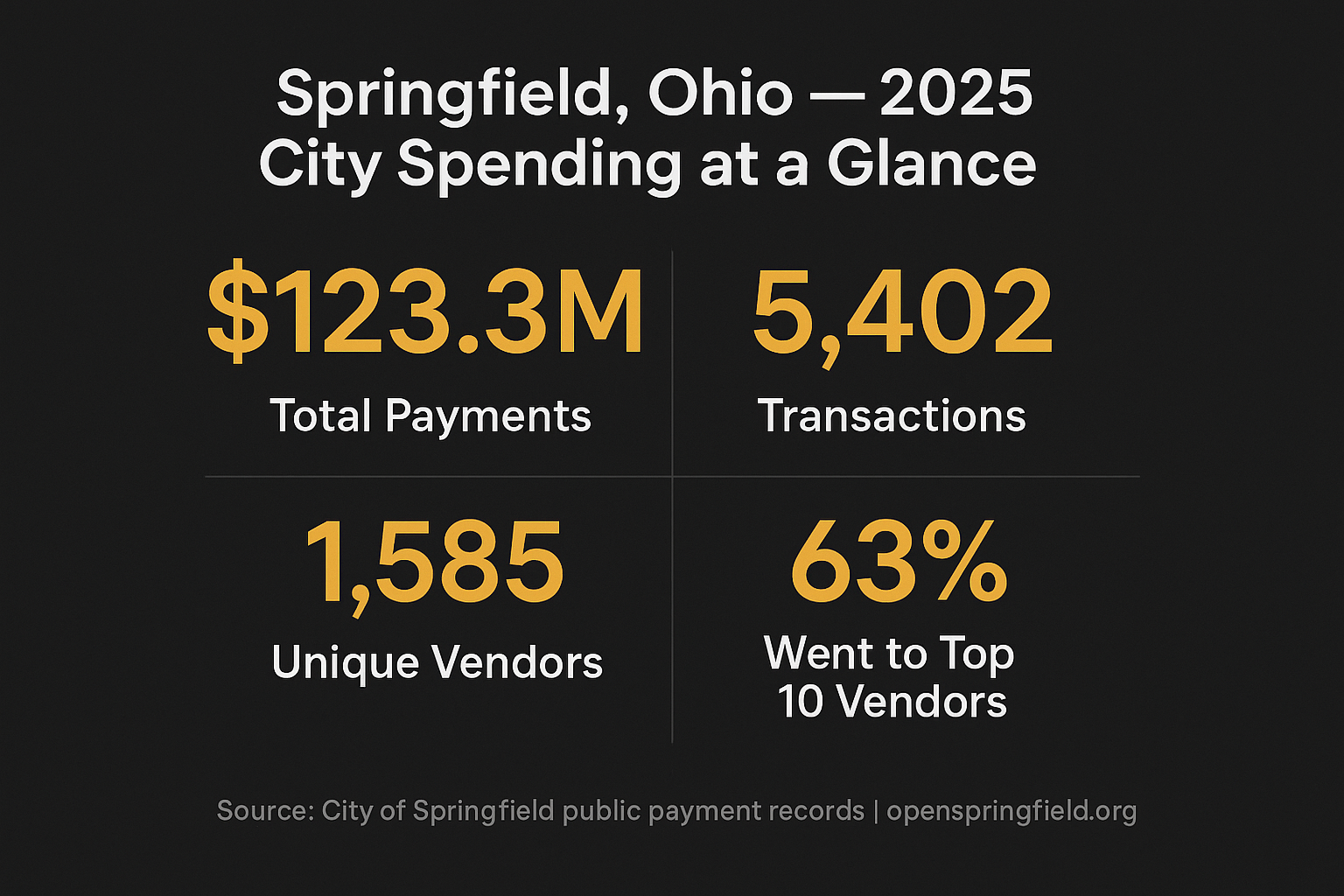
In 2025, the City of Springfield, Ohio made $123.3 million in payments to outside vendors. That money went to 1,585 different payees across 5,402 individual transactions. All of these figures come from actual city payment records obtained through a public records request.
This article presents what's in those records: who got paid, how much, and how often. We're not going to tell you what to think about it. The data speaks for itself, and now it's yours to explore.
The Top 20 Vendors by Total Payments
The following table shows every vendor that received $1 million or more from the City of Springfield in 2025. Together, these 20 vendors account for the vast majority of all Springfield Ohio spending recorded in the payment data.
| # | Vendor | Amount |
|---|---|---|
| 1 | US Bank Corporate Trust | $15.2M |
| 2 | 950 Pension Liability Fund | $13.0M |
| 3 | Jefferson Health Plan | $10.2M |
| 4 | 961 Health Care Fund | $10.0M |
| 5 | Treasury Investment Board | $6.9M |
| 6 | Ohio Water Development | $6.2M |
| 7 | Internal Revenue Services | $5.6M |
| 8 | Public Employees Retirement | $4.3M |
| 9 | Fire Disability & Pension | $3.1M |
| 10 | Police Disability & Pension | $2.8M |
| 11 | Ohio Edison Company | $2.4M |
| 12 | A&B Asphalt Corporation | $2.4M |
| 13 | Ferguson Enterprises | $2.1M |
| 14 | First Transit Inc | $1.9M |
| 15 | Truist Bank | $1.8M |
| 16 | Ohio Public Employees | $1.4M |
| 17 | OptumHealth Bank | $1.3M |
| 18 | Commissioner of Income Tax | $1.1M |
| 19 | Treasurer State of Ohio | $1.0M |
| 20 | Clark County Park District | $1.0M |
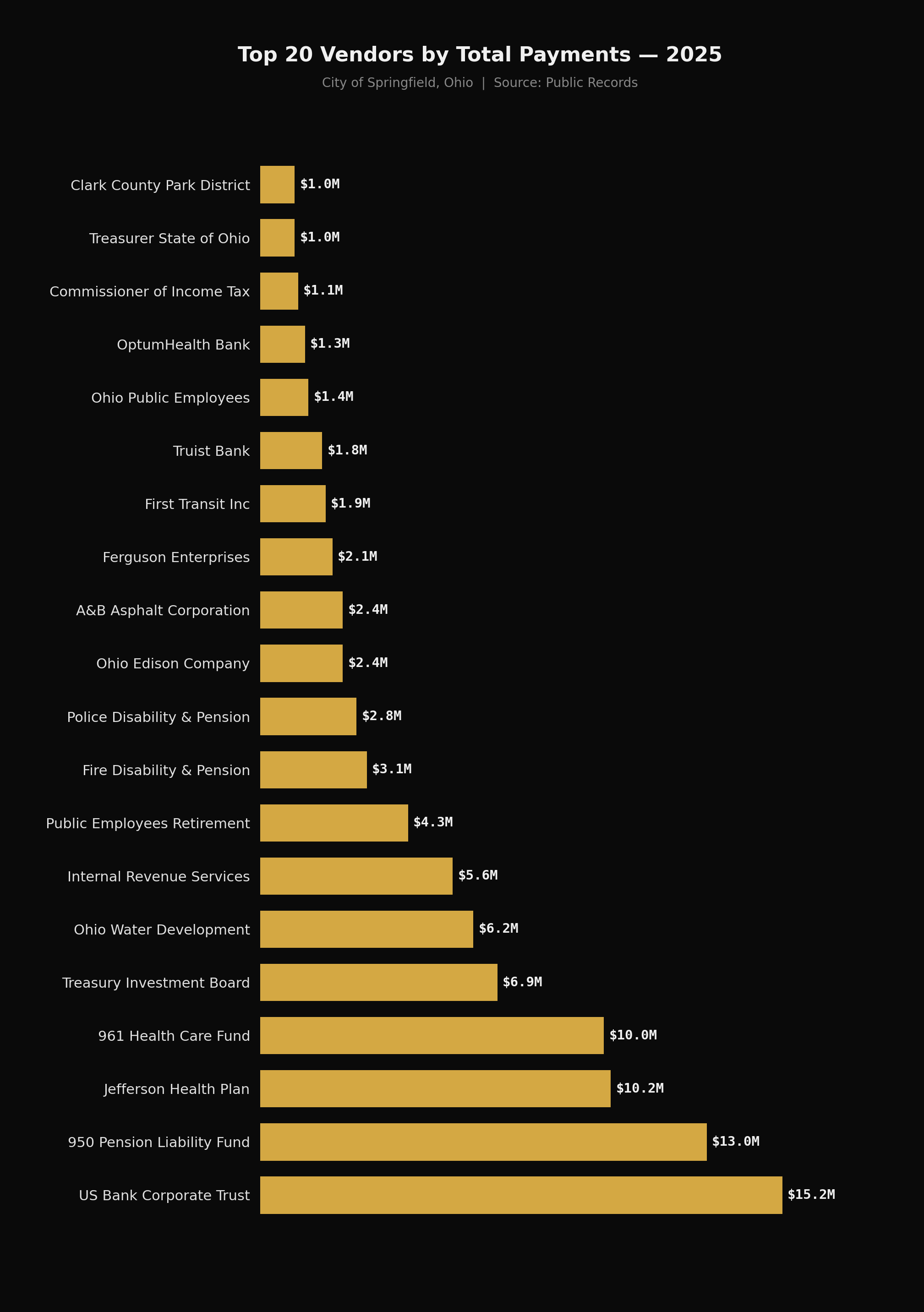
The top 10 vendors alone received roughly 63% of all Springfield Ohio spending, a combined $77.3 million out of $123.3 million. The remaining 1,575 vendors split the other $46 million.
What We Know (and What We Don't)
Here's where we want to be upfront about something. This data tells us who the city paid and how much. It does not tell us why.
The payment records we obtained don't include fund codes, department information, or purpose fields. That means we can see that the city paid US Bank Corporate Trust $15.2 million, but the data itself doesn't say what those payments were for. We can see "950 Pension Liability Fund" received $13.0 million, and that vendor name certainly suggests a purpose, but we're reading a name on a check, not a budget document.
We think this honesty makes the data more useful, not less. Other sites might sort these vendors into neat categories like "Debt Service" or "Health Insurance" based on vendor names alone. We could do that too, and some of those guesses would probably be right. But probably right isn't the same as verified, and we'd rather give you clean data than confident-sounding speculation.
What We Can Say for Certain
Some things are verifiable from public knowledge, not guesswork:
- Internal Revenue Services ($5.6M) — These are federal tax payments. That's what the IRS collects.
- Ohio Edison Company ($2.4M) — Ohio Edison is the electric utility serving Springfield. These are electricity payments.
- A&B Asphalt Corporation ($2.4M) — A&B Asphalt is a paving and asphalt company. They do road work.
- First Transit Inc ($1.9M) — First Transit is a national company that operates public bus services, including Springfield's transit system.
Beyond those, many vendor names suggest their purpose. "Fire Disability & Pension" and "Police Disability & Pension" are probably exactly what they sound like. "Jefferson Health Plan" is likely an employee health insurance provider. But we want to be clear: we're reading vendor names, and that's not the same as having confirmed budget line items with department codes and fund designations.
A Few Things That Stand Out
We're not going to tell you what to conclude from this data. But a few patterns are hard to miss:
The top of the list is dominated by financial entities. Banks, pension funds, health plans, tax agencies. The first vendor on this list that most people would recognize as providing a tangible product or visible service is Ohio Edison at #11, or A&B Asphalt at #12. The biggest payments go to institutions, not to the companies building or fixing things you can see around town.
The concentration is significant. Ten vendors received 63 cents of every dollar. That's typical for cities this size, where large recurring obligations take up most of the budget, but it's still striking when you see it laid out.
The "visible" spending is a fraction of the total. Ohio Edison ($2.4M), A&B Asphalt ($2.4M), Ferguson Enterprises ($2.1M), and First Transit ($1.9M) are the kinds of vendors whose work residents actually encounter: electricity, roads, water infrastructure, buses. Combined, that's $8.8 million, about 7% of total spending. The vast majority of Springfield Ohio spending goes to vendors whose work happens behind the scenes.
There are 1,565 other vendors below this list. The top 20 gets the attention, but there are hundreds of smaller vendors, many receiving just one or two payments. Local businesses, specialized contractors, equipment suppliers. That's where a lot of the texture is, and that's why we built a search tool.
What This Data Doesn't Include
Important context: This data covers City of Springfield vendor payments only. Here's what you won't find in these records:
• Schools. Springfield City School District is a separate entity with its own budget. None of that spending appears here.
• Clark County. County government operations, courts, the jail, county services — all separate.
• State of Ohio. State-funded projects happening in Springfield (highway construction, state building work) aren't in city payment records.
• Federal spending. Federal grants or programs that flow through other agencies won't show up here.
• Employee salaries. These are vendor payments, not payroll. You'll see aggregate tax payments to the IRS, but not what any individual city employee earns.
• Purpose or department codes. The records show who got paid and how much, but not which city department authorized the payment or what specific purpose it served. We can't tell you whether a payment came from the police budget, the parks budget, or the water fund.
This data is one piece of a larger picture. But it's a big piece: $123.3 million in payments that, until now, weren't easily accessible to the public.
Why We Built This
Springfield residents pay taxes. That money funds city operations. The records of how that money gets spent are public. But "public" doesn't always mean "accessible." Requesting records, waiting for responses, and then making sense of spreadsheets isn't something most people have time to do.
OpenSpringfield exists to close that gap. We did the records request. We cleaned up the data. We built a search tool so you can look up any vendor, any payment, any amount. All 5,402 transactions are in the database and open to anyone.
We're not here to push an agenda or score political points. We're here to make public data actually public. What you do with it is up to you.
Explore It Yourself
The real value of this project isn't in any article we write. It's in the tools. Want to know how much the city paid a specific company? Search for them. Curious who the biggest vendors are across all categories? Browse the vendor directory. Want the big picture? Check the spending dashboard.
Every dollar is in there. Go look.
Explore the Data Yourself
Every transaction, every vendor, every dollar. Search all 5,402 city payments from 2025.
Search All 5,402 Transactions →About the data: All figures in this article come from City of Springfield payment records obtained through a public records request. Data covers vendor payments made by the city during 2025. The payment records include vendor names, payment amounts, and transaction dates, but do not include fund codes, department designations, or purpose descriptions. OpenSpringfield is an independent civic transparency project and is not affiliated with the City of Springfield. Learn more about our methodology →